Amid the scale, noise, and intensity of the world’s toughest endurance rally, a quieter transformation has been taking place. From behind the wheel to off-track operations, Saudi women are becoming increasingly established within the Dakar Rally. This presence is a result of a natural progression shaped by access, talent, and earned credibility.
Now in its seventh edition in the Kingdom of Saudi Arabia, the Dakar Rally continues to elevate its role as a motorsport competition. As a result, participation and opportunities are increasingly being built locally, enabling Saudi women to be fully integrated within a world-class sporting environment.
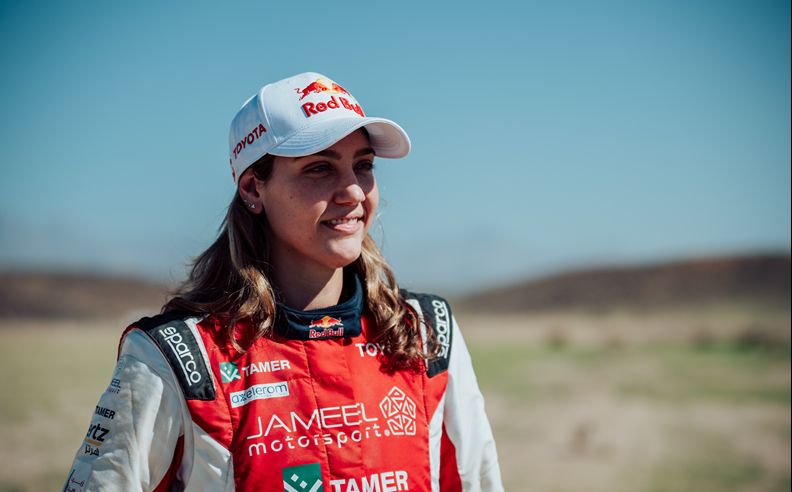
In the competitive field, that progression is embodied by Dania Akeel. The 37-year-old from Jeddah is one of the most experienced Saudi competitors in rally raid, with her credentials defined by her results in the category. A stage winner in the T3 Challenger Class at Dakar 12 months ago, Akeel went on to win the Abu Dhabi round of the FIA World Rally-Raid Championship, finishing third overall in the series last year.
Yet her relationship with Dakar has never been framed around representation. For Akeel, her home event is a personal and professional challenge, one that demands constant judgement, adaptability, and skill.
“It’s such a wonderful adventure,” she says. “In the Dakar Rally, you see the consequences of your decision-making instantly. It’s not an easy thing to do, but we are all here by choice, so we put ourselves through this experience for different reasons. I love to drive, but in these conditions, you learn a lot about yourself — it’s addictive.”
Saudi Arabia’s varied and memorable landscapes, from the Red Sea coast to the desert, amplify the challenge, forcing competitors to continually adapt, whether they are on rocky terrain or sand, and for Akeel, racing on home soil, there is an additional responsibility.
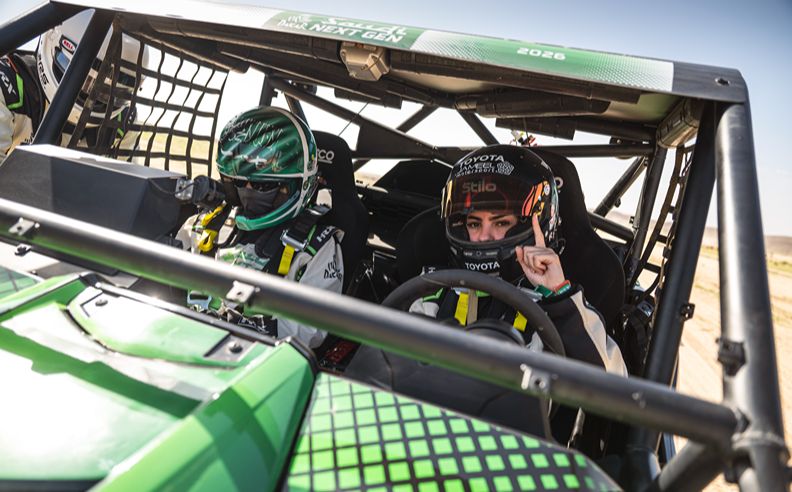
Although she is keen to avoid credit, Akeel’s visibility as a credible competitor acts as an inspiration for younger drivers coming through the motorsport ranks. That is emphasised by the inclusion of a development pathway for aspiring racers. Now in its second year, the Saudi Next Gen programme is designed to identify and develop future Dakar talent.
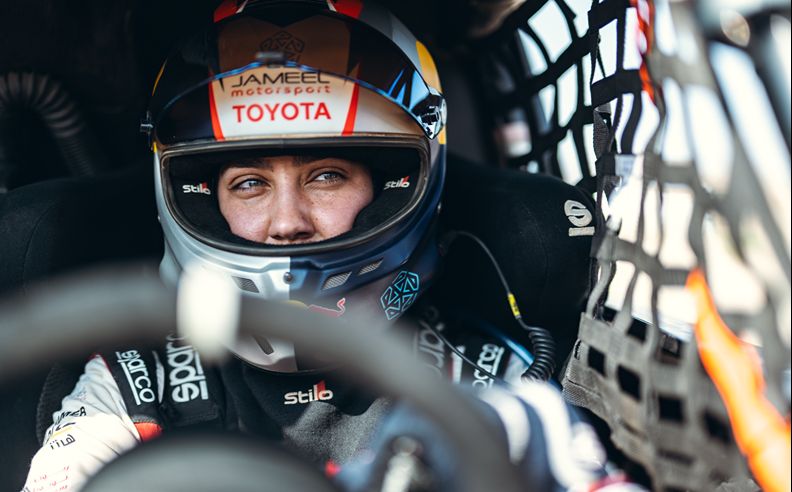
Running in the 2026 competition is Reem Al Aboud, a 25-year-old from Jeddah with her 23-year-old co-driver Shrooq Alamri from Riyadh. After beginning her motorsport journey in karting in 2018, Al Aboud made history as the first Saudi woman to drive a Formula E car. She has since transitioned into GT racing with Jameel Motorsport.
“Dania Akeel is an inspiration to all Saudi women wanting to join motorsports because she achieved so much in such a short amount of time,” says Al Aboud. “She proved that it’s possible to achieve what you want to dream of.”
The Saudi Next Gen programme focuses on more than just driving; it exposes participants to navigation, mechanical understanding, and endurance — the full spectrum of top-class rally-raid demands. And her visibility is helping to generate momentum.
“It’s an absolute honour. To have this opportunity to represent Saudi Arabia in such an amazing global competition is a goal I’ve been chasing since I first started racing,” she says. “And I’ve had a lot of young Saudis asking how they can get involved, where to go, how to get a racing licence.”
Alongside her, Shrooq Alamri represents another entry point into the motorsport ecosystem. Beyond competing, she has worked as a marshal at the Jeddah Corniche Circuit for both the Saudi Arabian Grand Prix and the FIA Formula E round, reflecting the widening range of roles now accessible within motorsport.
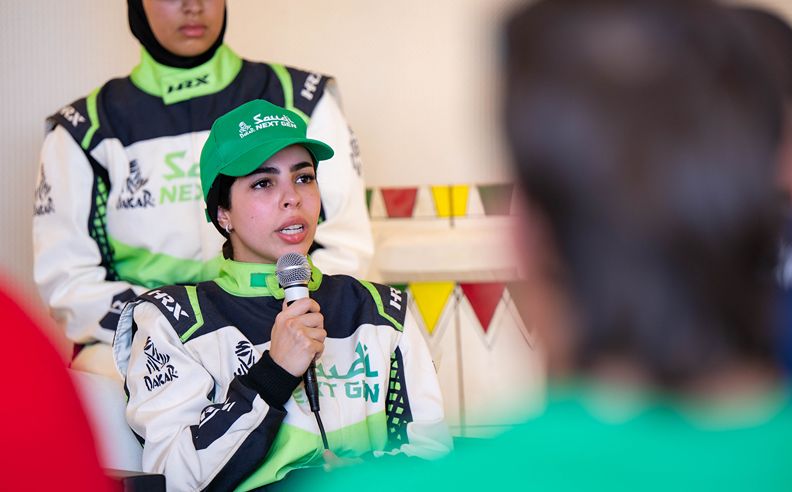
The rise of Saudi women at Dakar is not confined to the stages. Behind the scenes, women are increasingly embedded within the event’s operational and leadership structures.
The Dakar Rally, held under the supervision of the Ministry of Sport and organised by the Saudi Automobile and Motorcycle Federation, is promoted by the Saudi Motorsport Company. Its Director of Guest Management & Protocol, Maiss Dabbour, has seen that shift accelerate.
“There has been a clear and positive increase in women working for SMC,” she explains. “Across different departments and at varying levels of responsibility, contributing not only to operations, but also to leadership, strategy, and decision-making. The barriers to entry have significantly reduced. There are clearer pathways, stronger institutional support, and more opportunities across the motorsport industry.”
Taken together — across elite competition, development programmes, and executive roles — the presence of Saudi women at Dakar reflects a system that has matured. Inclusion has come not through symbolism, but through training, trust, and sustained opportunity.
“Visible success creates belief,” Dabbour says. “When the next generation sees women like Dania Akeel succeeding at the highest level, it shifts the mindset from ‘is this possible?’ to ‘where do I fit?’”
As host of the Dakar Rally for the seventh time, Saudi Arabia has accelerated that integration, enabling women to participate fully in motorsport’s ecosystem — not at the margins, but within its structure. At Dakar, progress is earned kilometre by kilometre. The rise of Saudi women within the world’s toughest rally follows the same rhythm: practical, professional, and now firmly established.
When Dania Akeel is asked what her message is, she says: “I want women to do what they want. To feel that they can make educated choices, to inform themselves, and have the right qualities to pursue their targets. My message is to do what comes naturally. Do it well, excel at it, work hard, and focus. Life is short, so we should all contribute what we have — everyone has something to give.”
The Dakar Rally Saudi Arabia 2026 is taking place from January 3 to 17, spanning 14 race days and featuring a Prologue and 13 competitive stages. The seventh edition hosted in the Kingdom brings together 787 competitors representing 49 nationalities, competing across 421 vehicles in multiple categories. The field includes 72 Ultimate cars, 45 trucks, 115 motorbikes, 7 Stock vehicles, 37 Challengers, 41 Side-by-Side vehicles, 75 Classic cars, 22 Classic trucks, and six Mission 1000 motorbikes, in addition to one truck, underlining the rally’s international reach and competitive diversity.
Moreover, the new 2026 route promises a challenge worthy of the Dakar name. Each region presents its own rhythm and demands, rewarding those who can adapt and stay focused across two intense weeks. As the rally unfolds, the diversity of the terrain and the scale of competition reflect the enduring spirit of Dakar and the growing role of Saudi Arabia as a defining stage for the world’s toughest rally.
Motor 283 is the biggest automotive website created by a team of automotive enthusiats and this author page is used to show the readers the press releases and news posted on Motor 283 website.




 SHARE
SHARE